Before We Talk About Voice AI
Try a small experiment.
Open the voice recorder on your phone and let it record for 10 minutes. Do not say anything. Just leave it on your desk.
When you listen to the recording later, you will gonna notice something interesting.
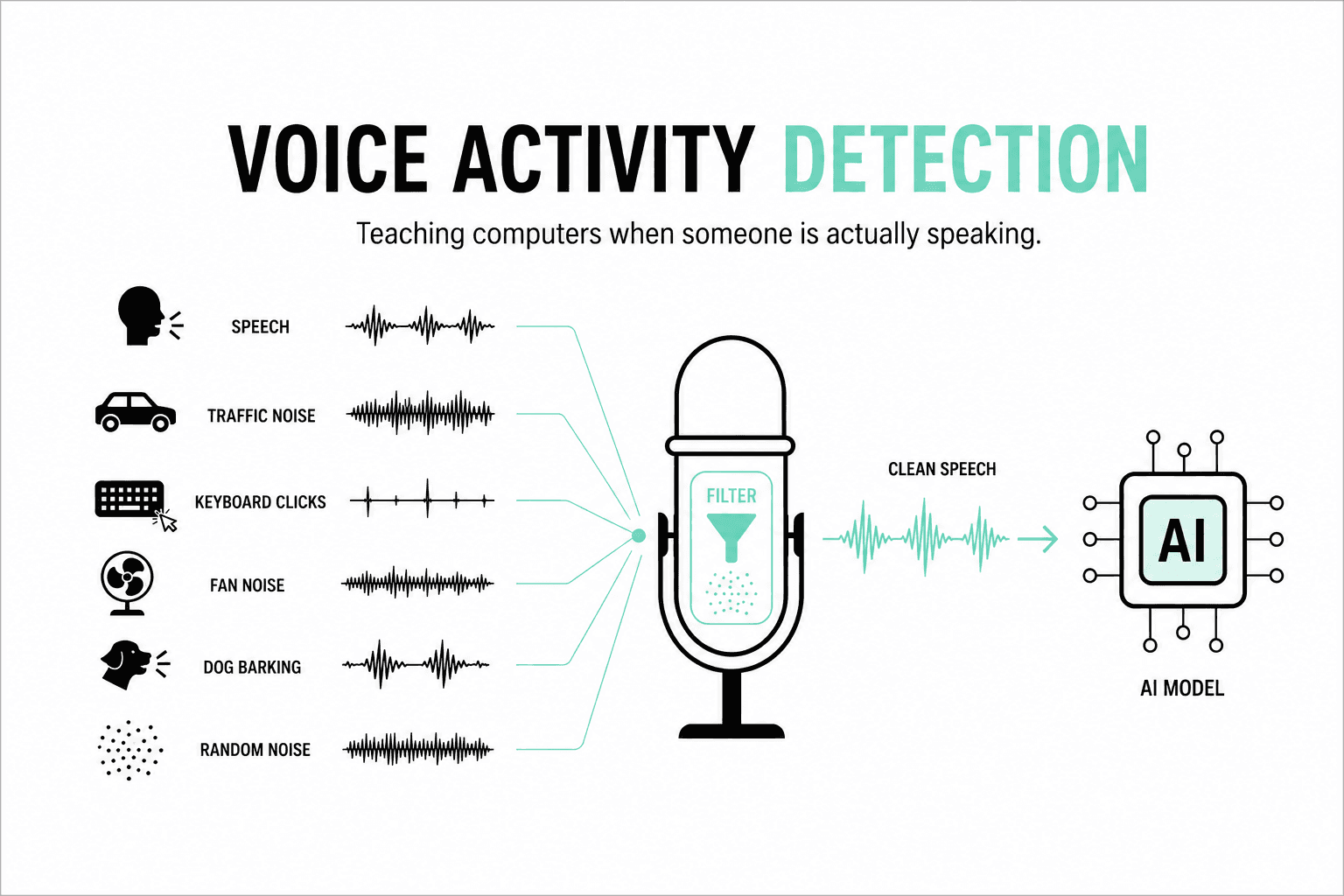
You'll hear the fan spinning in the background, keyboard clicks, someone walking past the room, a vehicle outside, maybe even a dog barking somewhere in the distance. Most of the recording is not speech at all. It's simply the world around you making noise.
Now think about using Google Assistant or Alexa.
You say,
"What's the weather today?"
Within a second, it understands your question and responds. Somehow, it ignores the fan, the keyboard, the traffic and every other sound happening around you.
How?
Most people assume the speech recognition system is doing all the work.
It is not.
Before any AI can understand what you're saying, it first needs to answer a much simpler question:
"Is someone actually speaking or not?"
That simple decision is made by a technology called Voice Activity Detection or simply VAD.
What is Voice Activity Detection?
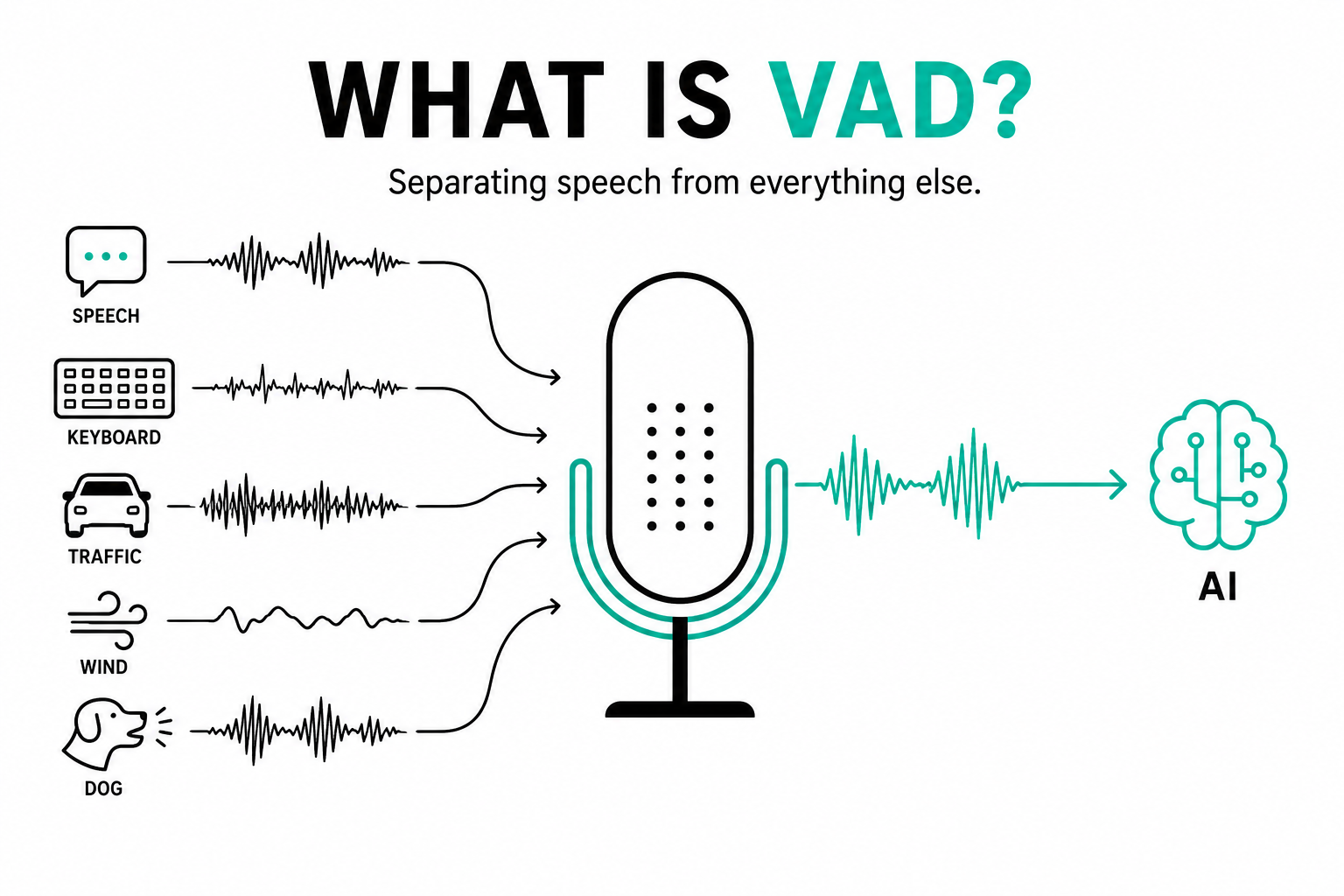
Voice activity detection is one of the first modules used in almost every speech recognition system today, and its job is surprisingly straightforward. It does not understand speech, translate anything, answer queries, or generate text. All it does is analyze an incoming audio signal and decide whether that audio contains human speech. That's the entire task - one decision, made over and over again: speech, or not speech.
Simple as it sounds, this is one of the most crucial stages in any speech-based application, because a mistake here carries forward into every module that follows.
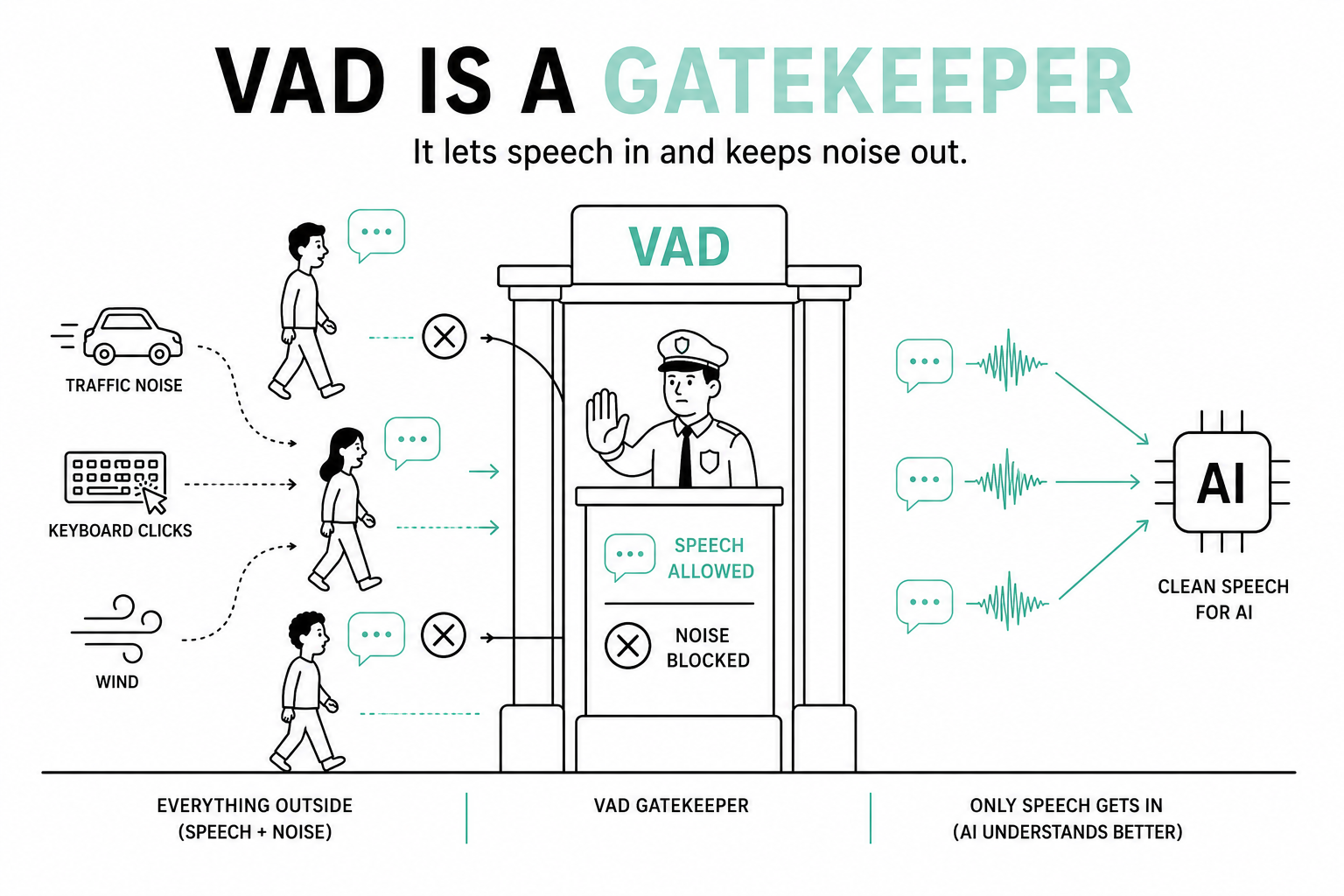
Think of voice activity detection as a company's receptionist. Before anyone enters the office, the receptionist identifies the visitor and directs them to the right department. VAD does the same thing for audio: before the speech recognition model is ever called, it decides that whether the incoming sound is worth processing at all.
Reading Audio Is not the Same as Understanding It
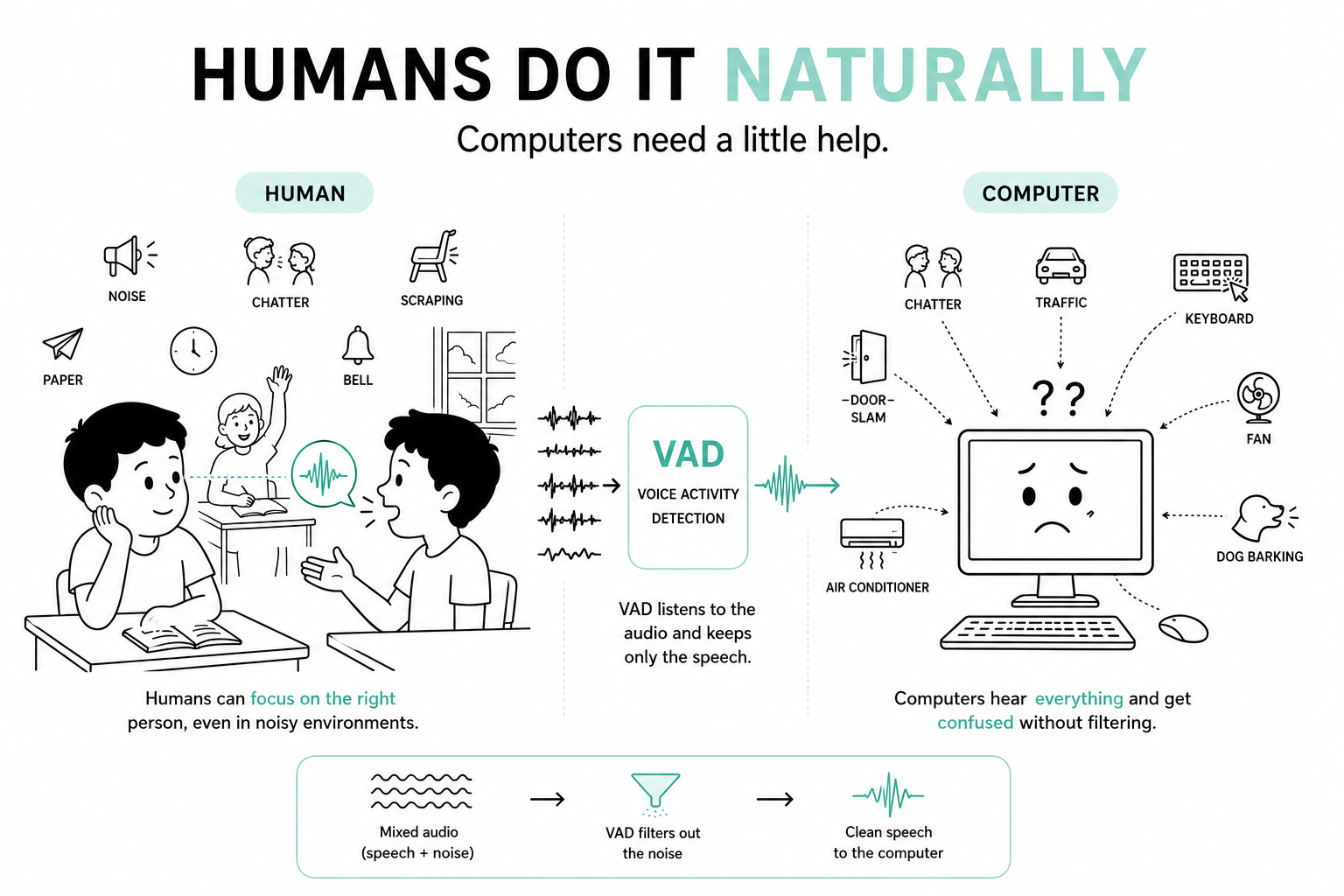
Imagine you're sitting in a cafe with a friend. People are talking around you, coffee machines are hissing, and music plays softly in the background. Even with all of that happening, you can still focus on your friend's voice without much effort right? Your brain naturally filters out the sounds that don't matter.
Computers don't have this ability. To a computer, everything coming from a microphone is simply a stream of numbers. It has no idea whether those numbers represent someone's voice, a car horn, or complete silence. Left on its own, it tries to process everything equally.
That's exactly the problem voice activity detection solves.
Why Do We Need VAD?
Imagine building a speech assistant without voice activity detection. Every second, it would try to make sense of the air conditioner humming, keyboard typing, traffic outside, footsteps, a door closing, background music and even sometimes complete silence. Instead of focusing only on your voice, the system wastes time and computing power on sounds that carry no useful information.
This creates several problems. The system becomes slower, because its going to processing audio it never needed to touch. It consumes more computing power, which drives up cost. And background noise can confuse the speech recognition model itself, reducing accuracy.
By filtering out everything except speech, VAD lets the rest of the AI pipeline run faster, cheaper, and more accurately. Sometimes the smallest component has the biggest impact.
Speech and Noise Are Not the Same
One of the biggest challenges in speech processing is separating speech from everything else.
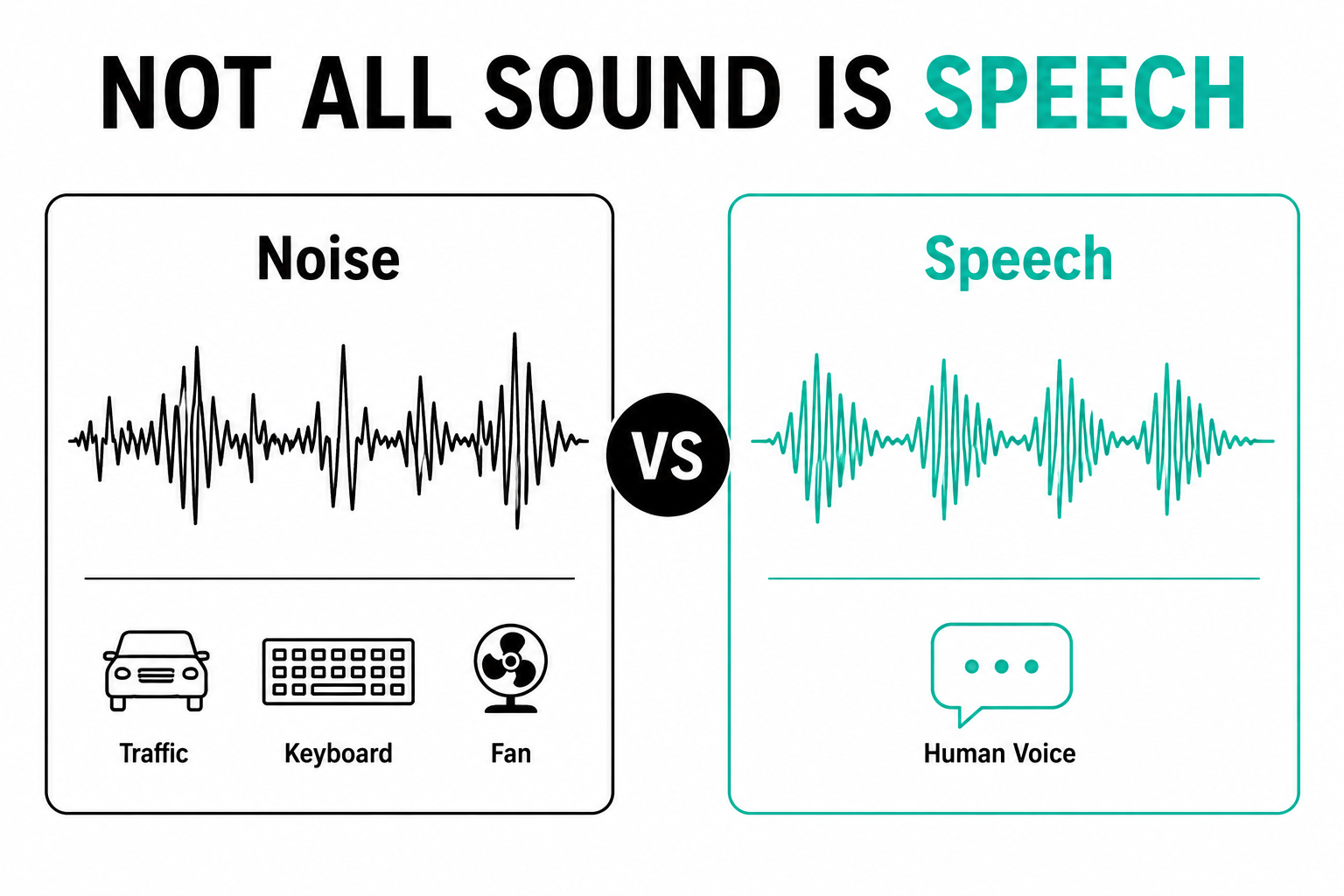
Consider the following sounds:
Speech
Normal conversation
Reading aloud
Voice commands
Phone calls
Singing
Noise
Keyboard typing
Fan noise
Traffic
Rain
Dog barking
Door closing
Air conditioner
Footsteps
Humans recognize this difference almost instantly but you don't decide that the dog barking is not a part of the conversation, you simply hear it that way. Computers have no such instinct. They need an algorithm to make that call.
That is exactly what voice activity detection is designed to do.
Where Do We Use Voice Activity Detection?
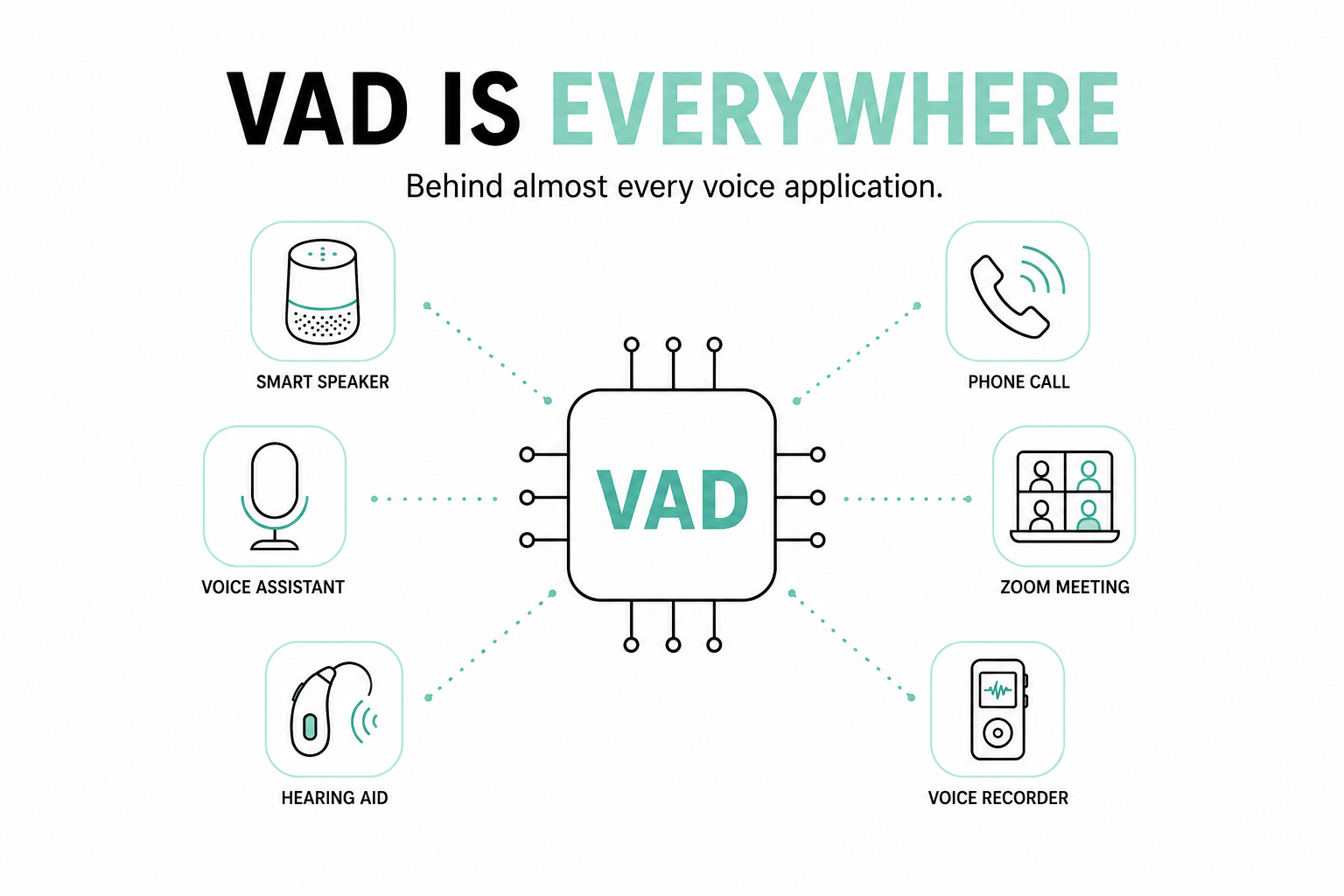
Although most people have never heard of VAD, they use it almost every day. Whenever a device listens to your voice, there's a good chance voice activity detection is running quietly in the background.
Some common examples include:
Google Assistant
Siri
Alexa
ChatGPT Voice Mode
WhatsApp voice notes
Zoom meetings
Microsoft Teams
Google Meet
Speech-to-text applications
Call centers
In all of these applications, VAD decides when speech starts and when it ends before any further processing happens. Without it, these systems would spend most of their time listening to noise instead of people.
How Does Voice Activity Detection Fit into the AI Pipeline?
Most beginners imagine that speech recognition begins the moment someone starts talking. In reality, another system starts working first.
A typical speech AI pipeline looks like this:
The microphone captures all surrounding audio.
Voice activity detection checks whether speech exists.
Only the speech segment moves on to the speech recognition model.
The recognized text is sent to an AI model like ChatGPT.
The AI generates a response.
Without VAD, every stage after it becomes less efficient. That's why voice activity detection is often called the gatekeeper of speech AI.
Different Ways to Detect Speech
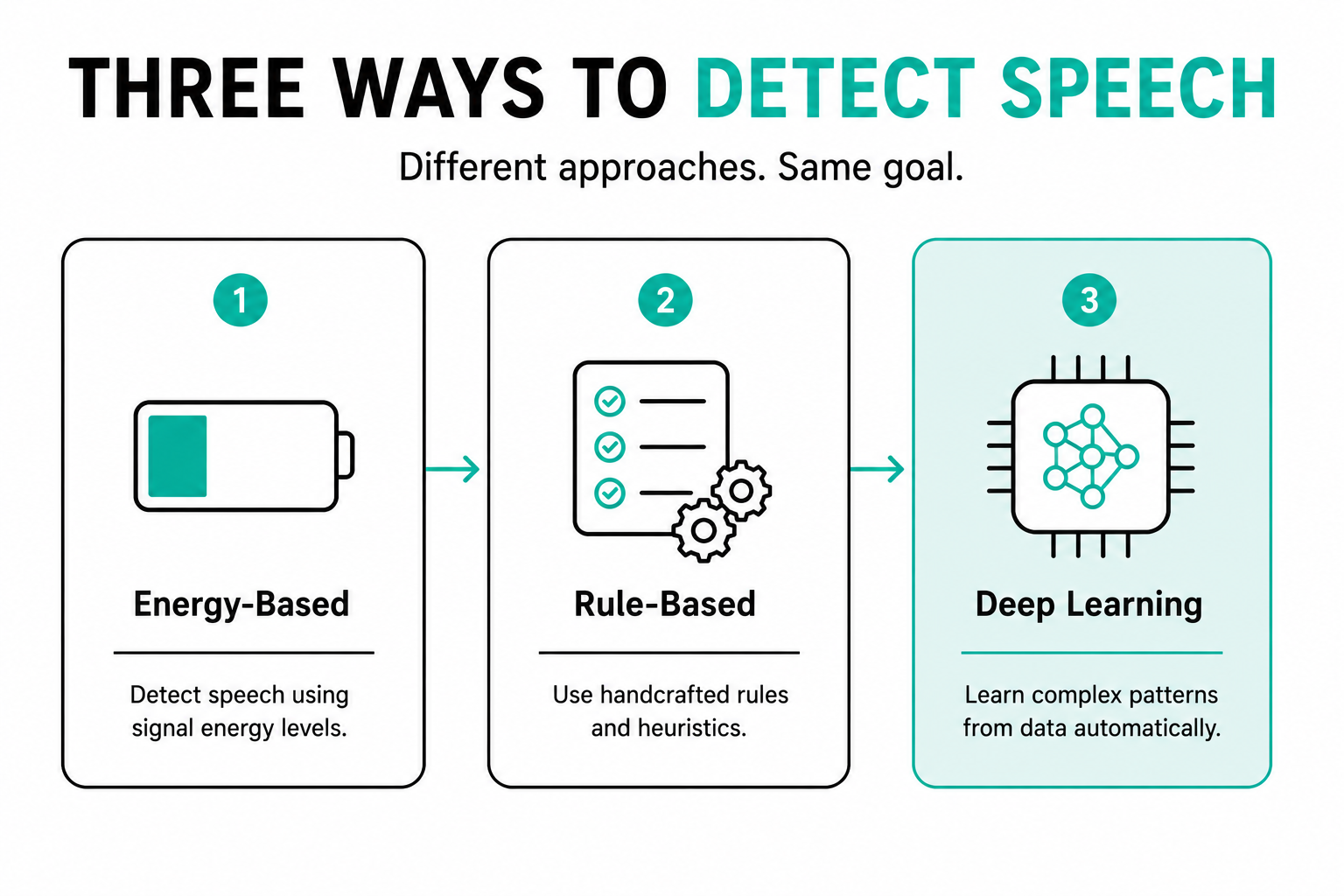
Over the years, researchers have developed different techniques to determine whether someone is speaking. Each approach solves the same problem in a different way.
Energy-Based VAD
This is the simplest approach. It measures how loud the audio signal is. If the sound crosses a predefined threshold, it assumes someone is speaking. It is extremely fast, but it struggles in noisy environments.
Rule-Based VAD
Instead of relying on loudness alone, this method looks at several characteristics of the audio, such as energy, frequency, and other signal properties. It performs better than energy-based VAD while remaining relatively lightweight.
Deep Learning-Based VAD
Modern systems use neural networks trained on thousands of hours of speech recordings. Instead of following manually defined rules, the model learns the difference between speech and noise directly from data. This approach is far more robust and is widely used in today's commercial speech applications.
We will explore each of these approaches in detail later.
Final Thoughts
Voice activity detection isn not the most famous part of artificial intelligence, but it's one of the most essential. Before an AI assistant understands your question, before subtitles appear during a meeting, and before your voice is converted into text, another system quietly decides whether you're speaking at all.
That system is voice activity detection.
It may only answer a simple yes-or-no question, but that small decision saves computation, improves accuracy, reduces processing time, and makes modern voice applications feel seamless.
So the next time you ask your phone a question or join an online meeting, remember that the first AI working behind the scenes isn't the one generating the response. It's the one deciding whether there's a voice worth listening to.